
Property Developers Shift Focus to Integrated Industrial Townships to Support India's Manufacturing Growth Ambitions
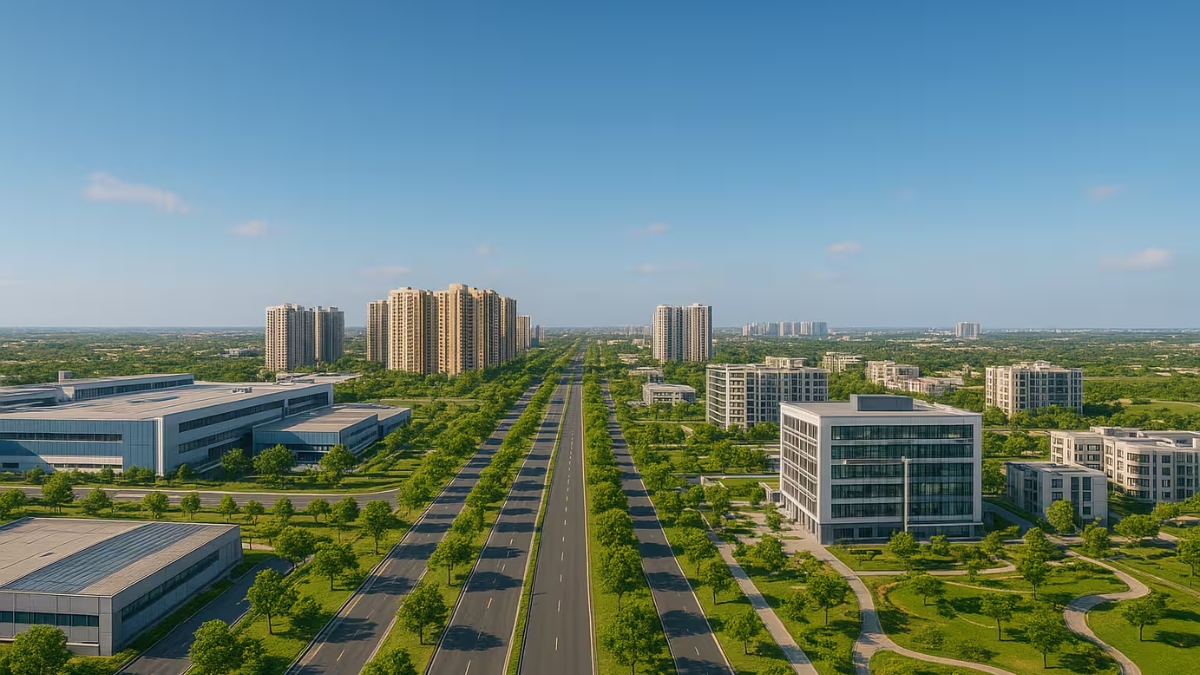
New Delhi, March 23, 2026: Property developers are sharpening focus on integrated industrial townships to capitalise on the government's aim to grow the share of manufacturing to 25% of GDP by 2035. Experts say this would drive demand for industrial plots as an alternative investment avenue .
Key Developers and Projects
Leading developers such as M3M, Signature Global, Reliance, and LML Realty are currently building industrial townships in NCR. In the South, Brigade Group recently launched Brigade Industrial Park, a 25-acre industrial development in Devanahalli, North Bengaluru, as part of its expansion into industrial real estate .
Reliance Model Economic Township is an 8,250-acre integrated smart city and global manufacturing hub in Jhajjar, Haryana. LML Realty has advanced development of its 35-acre LML Industrial Park, aimed at strengthening the manufacturing and MSME ecosystem through infrastructure-led, systems-driven industrial development. Over the next five years, the LML Industrial Park is expected to support over 1,000 crore in cumulative factory-level investment across more than 50 operating units, while enabling employment for over 7,000 people .
Evolution in Industrial Development
"A large part of the activity is concentrated in a handful of locations where infrastructure, connectivity, and execution have come together effectively, even though over 100 nodes have been planned across industrial corridors," said Shrivallabh Goyal, CEO and WTD at Reliance Model Economic Township. "One of the reasons earlier townships did not scale beyond manufacturing hubs was that they were largely built as land aggregation exercises. Industrial activity came in, but the surrounding ecosystem of housing, social infrastructure, and talent pools did not evolve at the same pace" .
The shift reflects a broader move toward more cohesive planning, where industrial land, logistics, and infrastructure are developed in tandem for efficiency and competitiveness. This transformation has also positioned industrial real estate as an emerging investment option, with investors increasingly viewing industrial projects as a stable, long-term asset class .
Government Initiatives Driving Momentum
"Government-led initiatives such as PCPIR (Petroleum, Chemicals and Petrochemicals Investment Region) have played a pivotal role in driving this momentum," said Siraj Saiyed, director of Arete Group. "The Gujarat PCPIR region, with Dahej as a key node, highlights the impact of large-scale, policy-backed industrial ecosystems. The region has attracted investments exceeding 1 lakh crore, with a strong concentration of petrochemical, chemical, and engineering industries, supported by port-led development and robust connectivity" .
Recently, the Union cabinet approved 33,660 crore for the BHAVYA scheme, which proposes the setting up of 100 industrial clusters, as announced in the recent budget .
Industrial Real Estate as Investment Class
"A shift, or evolution, in buyer behaviour has been observed," said Pratyush Pandey, founder of AARE Consulting. "Industrial plots are no longer viewed purely as end-use assets but are increasingly emerging as a compelling alternative investment class, driven by long-term appreciation potential and improving liquidity in key corridors. The industrial and warehousing sector, in particular, is fast becoming a high-growth frontier" .
Future Outlook
According to Colliers' latest report, multiple cities are likely to emerge as frontrunners of industrial and warehousing growth over the course of the next few decades, driven by factors such as continued regulatory support through corridor development programmes, the PM Gati Shakti programme, and the National Logistics Policy .
"Manufacturing-led growth depends on reliable systems," said Yogesh Bhatia, Managing Director & CEO of LML Realty. "When infrastructure, compliance, and governance are built correctly from the outset, enterprises can focus on producing, employing, and scaling. That is how industrial capacity compounds at a national level" .